What Are Standards, Frameworks, and Regulations, and Why Do They Matter?
When organisations mention ISO/IEC 27001, ISO/IEC 42001, SOC 2, GDPR, NIS 2, or DORA, they’re referring to different rules and guidelines that govern how security, risk, and governance are managed.
These are not all the same, and knowing the difference is the first step to understanding.
Put simply:
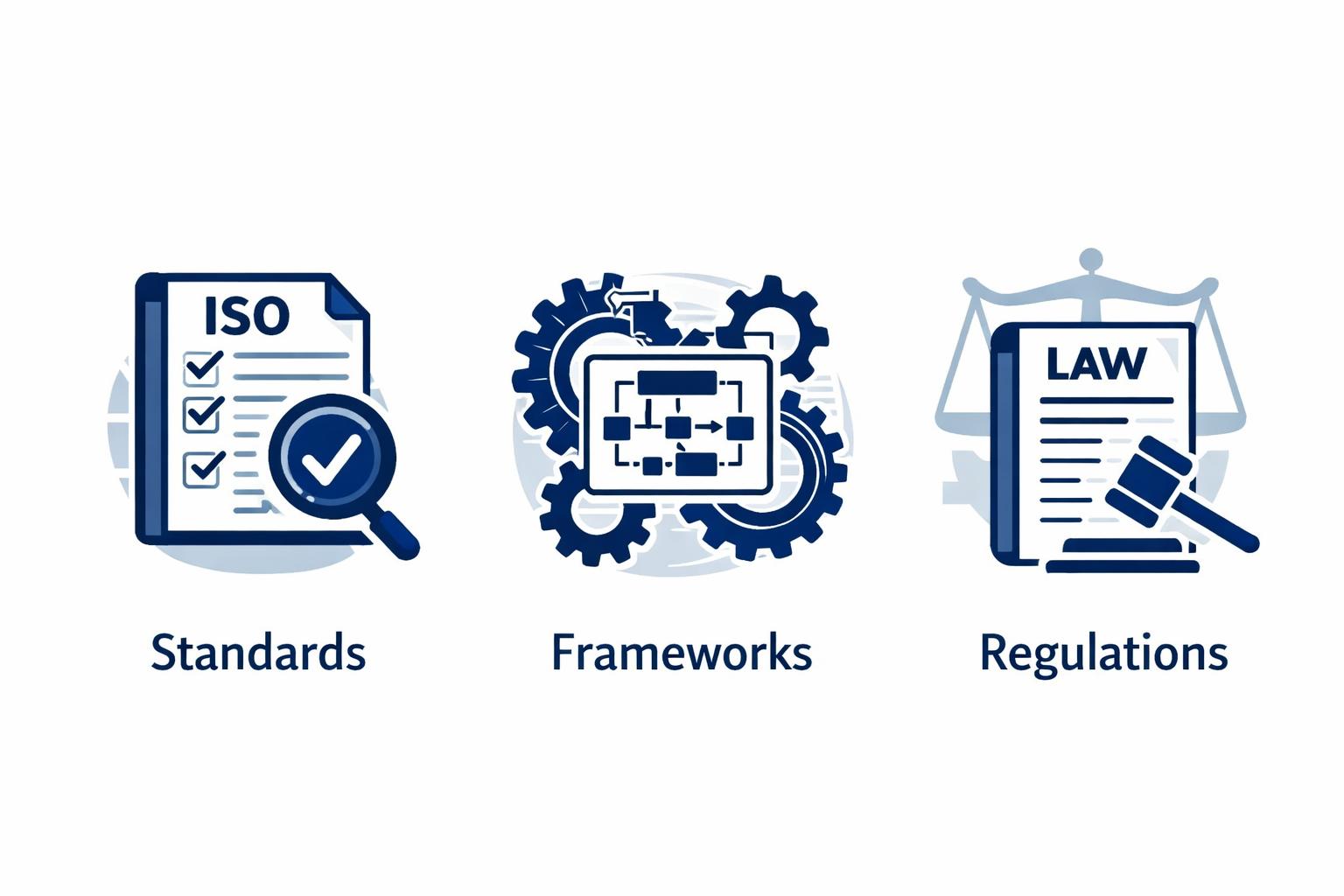
Standards show you what best practice looks like.
Frameworks help you organise your approach and make improvements.
Regulations and laws set out what you are required to do.
At Meridian GRC Consulting, our role is to help organisations like yours see how these fit together and how to apply them in ways that work for your business.
Standards
Standards show us what ‘good’ means in practice.
They provide clear, auditable rules for managing things like information security and privacy.
Example: ISO/IEC 27001:2022
ISO/IEC 27001 explains how to identify key information, manage risks, implement controls, and demonstrate their effectiveness.
The standard focuses on governance, making decisions based on risk, and using evidence, rather than recommending specific tools.
Clarity comes from turning requirements into practical actions.
Assurance comes from demonstrating effectiveness through audit and evidence.
Frameworks
Frameworks help organise and improve security.
They provide structure and shared language, but are not usually certifiable.
Example: NIST Cybersecurity Framework
The NIST CSF groups security into six functions: Govern, Identify, Protect, Detect, Respond, and Recover, and helps organisations understand gaps, prioritise improvements, and align security with business objectives.
Clarity comes from using a shared structure to understand gaps, priorities, and maturity.
Assurance comes from showing that improvements are consistent, repeatable, and aligned to business objectives.
Regulations
Regulations are mandatory.
Regulations establish legal obligations and are enforced by regulatory authorities.
Examples include the GDPR, NIS 2 Directive, and Digital Operational Resilience Act (DORA).
These regulations require organisations to protect data, manage risk, maintain effective security governance, and demonstrate operational resilience in practice.
Clarity is achieved by translating regulatory requirements into specific governance, risk, and control expectations.
Assurance is provided by demonstrating compliance to regulators through documented controls, clear accountability, and supporting evidence.
How It All Fits Together
Regulations set obligations.
Standards provide a certifiable way to meet them.
Frameworks structure and mature controls.
Aligned properly, compliance becomes predictable, defensible, and sustainable.
Our Role
Here’s what we offer:
We provide:
Clarity by simplifying complex requirements.
Assurance by validating controls and evidence.
Compliance through measurable, auditable outcomes.
This is how security and governance move from obligation to trust.